SERP features · the field guide
SERP features: the twelve blocks that shape a Google results page.
Modern results pages are built from typed blocks — an AI Overview here, a local pack there, ten blue links somewhere underneath. This page names the twelve features you’ll actually meet, what earns a place in each, and how ownership is tracked once you hold one.
SERP features are the elements on a search results page beyond the classic organic links — AI Overviews, featured snippets, local packs, People Also Ask boxes, and similar blocks.
The twelve, one by one
Twelve SERP features, from the answer down to the ads.
Ordered roughly as they appear on the page — the answering blocks first, the paid frame last. The mono note on each says who a place in it goes to.
- AI Overviewgenerated · cites sources
- Google’s generated answer, shown above everything else and citing a short list of source pages. The citation is the part a site can win; presence and sources both shift day to day.
- Featured snippetanswer box · one winner
- A single result promoted into an answer box at the top of the organic column. It is drawn from a ranking page, so it can be won, held, and lost — ownership is a trackable fact.
- People Also Askquestions · expandable
- A folding list of related questions, each opening a short answer taken from a ranked page. The list grows as it is used, and the box appears across a large share of queries.
- Local packmap · three places
- The map block with a short list of local businesses, shown when the query reads as nearby intent. Placement is earned through the business profile more than the website.
- Knowledge panelentity · brand-owned
- The entity card — company, person, place — filled from Google’s knowledge graph. You influence it by managing the entity’s public record, not by ranking a page.
- Image packimages · in-column row
- A row of image results inside the main column, on queries where people expect to look rather than read. Your images compete for it through image search.
- Video resultsvideo · thumbnails
- Video thumbnails on how-to and demonstration queries, each opening the video itself. Winnable with the right media on the right query.
- Top storiesnews · recency-ordered
- The news carousel on fresh topics, drawn from news sources and ordered by recency as much as by rank.
- Sitelinksyour pages · granted
- Extra links to a site’s inner pages beneath its main result, mostly on branded queries. Granted by the engine, not requested.
- Product resultsshopping · prices
- Product cards with thumbnails and prices on shopping queries, fed by merchant listings rather than page rank alone.
- Discussions and forumscommunity · threads
- A block of forum and community threads, shown where Google reads a want for first-hand opinion over polished pages.
- Adspaid · labeled
- Sponsored results above and below everything organic. Bought, not ranked — they share the page but not the game.
The count is honest arithmetic, not a standard: Google ships and retires features without notice, and published guides count anywhere from 17 to 40 depending on how variants are split. These twelve are the ones that keep appearing.
See which blocks your keyword’s page carries — run a free check
The newest feature answers first
The AI Overview changed what “position one” means.
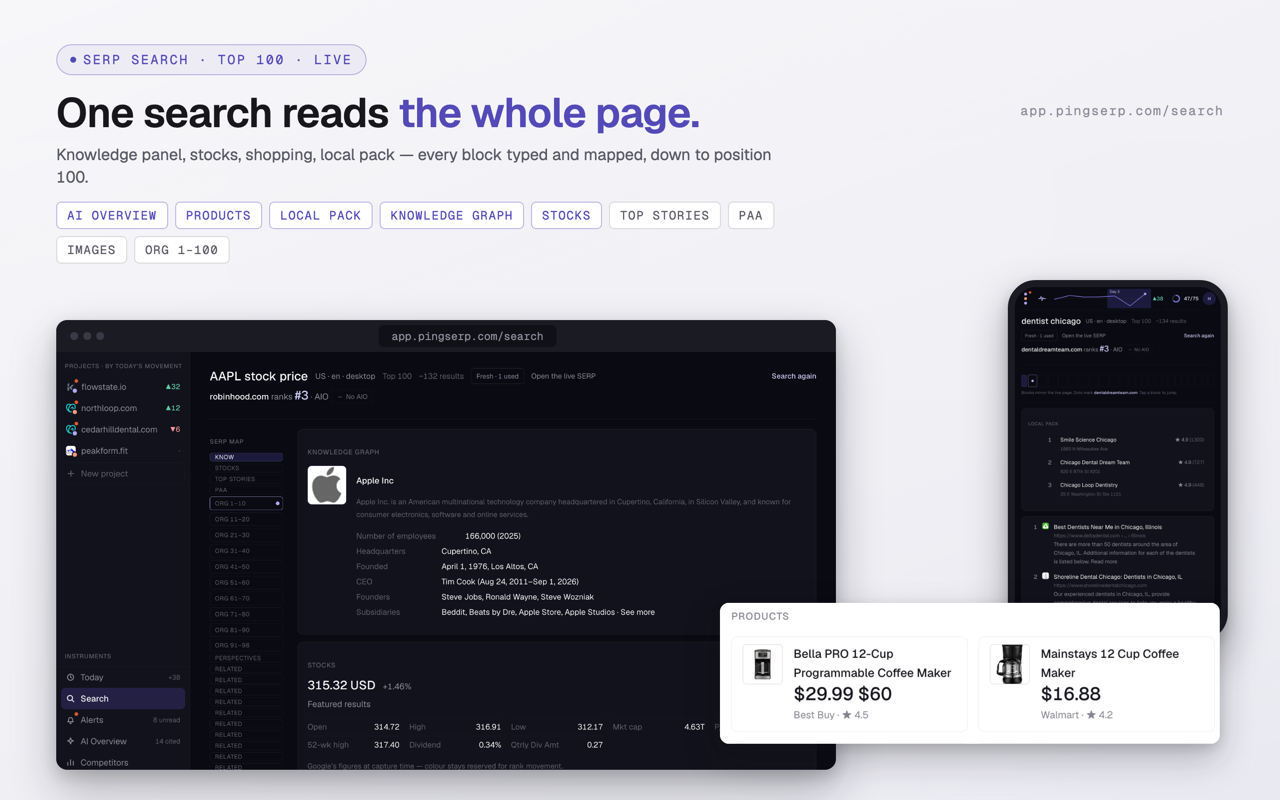
Most features decorate the page; the AI Overview pre-empts it. When one appears, it answers before any result is seen, and it cites a handful of sources. The question stops being “who ranks first” and becomes “who is in the answer”.
PingSerp records the state per keyword — cited, in the AI Overview but not cited, or no AI Overview — with every cited source named, next to the classic position.
SERP feature tracking
Features are rankings too. Track them like rankings.
A position tells you where your link sits; the features tell you what the page does around it. PingSerp records both. Every tracked keyword carries its SERP-feature set, and the ownable blocks — featured snippet, local pack, AI Overview citation — are recorded as yours or not, with the date either changes.
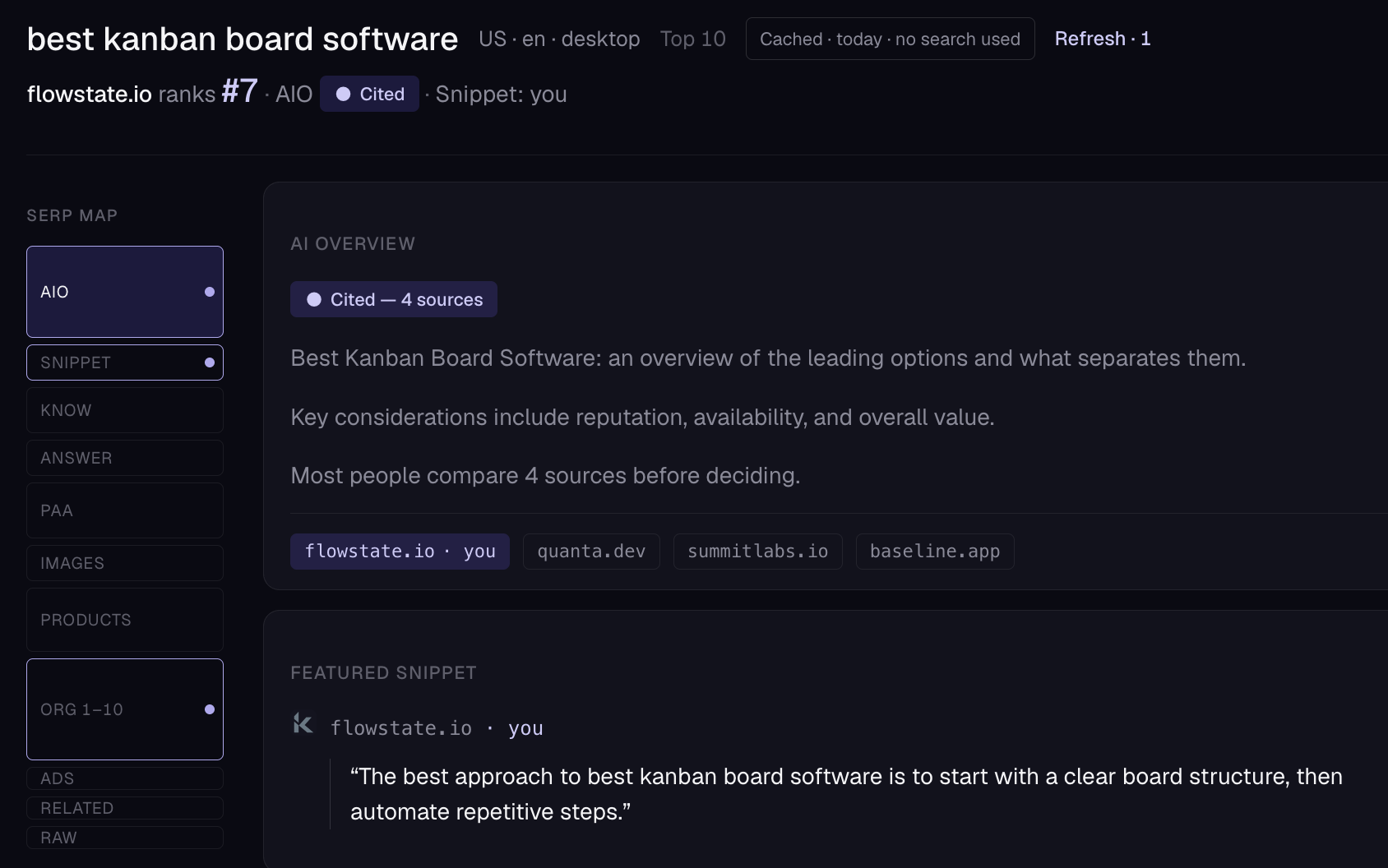
The live search goes further and types every block on the page, down to position 100: knowledge panels, product cards, local packs, each mapped where it sits.
Ranking for features · reading the page
How to rank for SERP features
To rank for SERP features, first find out which features your keywords actually show — a block you can see is a slot you can contest. Then match the format each block rewards, and track ownership daily, because features change hands without ceremony.
- Map the features per keyword: run a free SERP check or a live search and read which blocks the page carries.
- Contest the ownable ones: a concise, self-contained answer paragraph for the featured snippet, a maintained business profile for the local pack, a citable source page for the AI Overview.
- Skip the ones you can’t win: knowledge panels belong to entities and ads to budgets. Effort spent there is effort taken from the winnable blocks.
- Track ownership over time — the daily wave records featured snippet, local pack and AI Overview citation as held or lost, with dates.
What does a SERP include?
A search engine results page includes three kinds of content: paid results, the classic organic links, and the features listed above — answer blocks, maps, media rows and the AI Overview. On a modern page the features often take the visible space above the fold; the ten blue links are still there, lower than they used to be.
Are SERP features the same on mobile and desktop?
No. The two pages are composed separately: the phone SERP leans harder on local packs and vertical media, the desktop page keeps side-rail features like the knowledge panel, and positions differ along with the layout. If mobile is where your audience is, measure the mobile page itself — that’s what a mobile rank tracker is for.
Quick answers
About SERP features
How many SERP features are there?
There is no official count. Google ships, tests and retires features continuously, and published guides count anywhere from 17 to 40 depending on how variants are split. The twelve on this page are the recurring ones — the set you’ll actually meet across ordinary commercial and informational queries.
Which SERP features can a website win?
Five are directly winnable by a page or profile: the featured snippet, a People Also Ask answer, an AI Overview citation, a local pack place, and product results. Image and video blocks are winnable with the right media. Knowledge panels belong to entities, and ads are bought — neither is won by ranking.
Is the AI Overview a SERP feature?
Yes — the newest consequential one. It behaves differently from the rest: it generates an answer instead of promoting a result, and it cites sources rather than crowning a single winner. PingSerp treats it as its own discipline, with a free AI Overview checker and three tracked states per keyword.
What is the difference between SERP and SEO?
A SERP is a thing — the search engine results page a query returns. SEO is a practice — the work of earning better places on that page. SERP features connect the two: they define which places exist beyond the classic ranked links.
Do SERP features affect click-through rates?
Yes, in both directions. A feature you own adds a second surface above your organic link; a feature someone else owns pushes your link further down, and an AI Overview can answer the query before any click happens. That is why feature ownership is worth recording next to position.
From reading to measuring
Your SERP has features. Know which ones you hold.
Run one free check: your position, the AI Overview’s verdict, and the page around them. Tracking then records the features per keyword — held, lost, and dated.